Informations sur le sujet du timbre 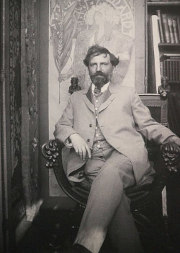
Alphonse Mucha
aussi orthographié Alfons Mucha et Alphons Mucha, né à Eibenschütz le 24 juillet 1860 et mort à Prague le 14 juillet 1939, est un affichiste, illustrateur, graphiste, peintre, et professeur d'art tchécoslovaque. Il est un représentant majeur du style Art nouveau.
Lorsque, en 1897, il compose cette image publicitaire intitulée Rêverie pour Champenois, son éditeur et imprimeur, Alphonse Mucha s’est installé à Paris depuis dix ans. L’Art nouveau se déploie avec la vivacité d’un mouvement que l’époque reconnaît comme une émanation d’elle-même, fascinée et inquiète de l’industrialisation qui transforme le monde
Natif de Moravie (aujourd’hui en République tchèque) et arrivé de Vienne à Paris en 1887, Mucha est catapulté sur le devant de la scène artistique en 1894 par une collaboration avec l’actrice Sarah Bernhardt qui joue alors dans Gismonda. L’affiche qu’il compose lui ouvre les portes d’un partenariat avec l’actrice qui durera six ans et d’un monde qui, en retour, s’empare avec enthousiasme de son iconographie complexe. Par la suite, Mucha préfèrera ne pas être associé de manière trop exclusive avec l’Art nouveau et, après s’être installé à Prague, il se consacrera à la réalisation de ce qu’il considèrera comme son grand œuvre – une série de toiles monumentales représentant l’Épopée slave –, mais la popularité de ses affiches et lithographies bénéficiera d’une longévité hors du commun, témoin de leur caractère intemporel. Source © La Poste - Tous droits réservés
Alphonse Mucha
also spelled Alfons Mucha and Alphons Mucha, born in Eibenschütz on 24 July 1860 and died in Prague on 14 July 1939, was a poster designer, illustrator, graphic artist, painter, and teacher of Czechoslovakian art. He is a major representative of the Art Nouveau style.
When he composed this advertising image entitled Rêverie pour Champenois in 1897, his publisher and printer, Alphonse Mucha had been living in Paris for ten years. Art nouveau unfolds with the vivacity of a movement that the era recognizes as an emanation of itself, fascinated and concerned by the industrialization that transforms the world
Born in Moravia (now in the Czech Republic) and arrived from Vienna to Paris in 1887, Mucha was catapulted to the forefront of the artistic scene in 1894 by a collaboration with the actress Sarah Bernhardt who then played in Gismonda. The poster he composes opens the doors of a partnership with the actress that will last six years and a world that, in return, takes over her complex iconography with enthusiasm. Afterwards, Mucha would prefer not to be associated too exclusively with Art Nouveau and, after settling in Prague, he would devote himself to the realization of what he considered his great work – a series of monumental paintings representing the Slavic Epic. but the popularity of his posters and lithographs will benefit from an extraordinary longevity, a witness to their timeless character. Source © La Poste - All rights reserved