Informations sur le sujet du timbre 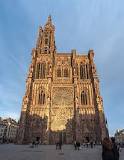
Cathédrale de Strasbourg (Image Wikipédia)
La cathédrale Notre-Dame de Strasbourg
Notre-Dame de Strasbourg est la plus vieille cathédrale gothique au monde. Sa flèche culmine à 142 mètres, ce qui en a fait la plus haute de tour du monde chrétien jusqu'en 1874. L'édifice repose sur des fondations de 1015, uniques au monde : la cathédrale est posée sur un socle de limon et d'argile renforcé par des pieux en bois enfoncés dans la nappe phréatique. Le chantier de la cathédrale actuelle commence sur les fondations de la construction précédente et ne s'achève que plusieurs siècles plus tard, en 1439
Le premier maître d'oeuvre attesté du chantier de la cathédrale est Erwin von Steinbach. Sa fonction de responsable du chantier de la cathédrale a été officialisée le 16 octobre 1284 dans un contrat avec la chancellerie de la ville.
L'horloge astronomique est la grande attraction de la cathédrale. Son jeu d'automates attire trois millions de curieux chaque année. Il est visible tous les jours à 12h30. L'horloge indique l'heure, les calendriers civil et religieux et des données astronomiques. Elle a précisément relevé une éclipse de lune le 28 mars 2006. Elle est installée dans un buffet du XVIe siècle, mais son mécanisme ne date que de 1842. Il est l'oeuvre du strasbourgeois Jean-Baptiste Schwilgué, génie autodidacte à la fois mathématicien, astronome et mécanicien. Aujourd'hui, un conseil scientifique et un horloger veillent sur l'horloge, qui est remontée tous les lundis.
Source : divers documents internet dont Wikipédia
The Notre-Dame de Strasbourg
Notre-Dame de Strasbourg is the oldest Gothic cathedral in the world. Its spire reaches 142 meters, which made it the highest tower in the Christian world until 1874. The building rests on foundations from 1015, unique in the world: the cathedral is placed on a base of silt and clay reinforced by wooden piles embedded in the water table. The construction of the present cathedral begins on the foundations of the previous building and is only completed several centuries later, in 1439
The first architect who was involved in the construction of the cathedral is Erwin von Steinbach. His position as the head of the cathedral’s construction was formalized on 16 October 1284 in a contract with the city chancellery.
The astronomical clock is the cathedral’s main attraction. Its game of automata attracts three million curious people every year. It is visible every day at 12:30. The clock shows time, civil and religious calendars and astronomical data. She specifically observed a lunar eclipse on March 28, 2006. It is installed in a 16th century buffet, but its mechanism dates only from 1842. It is the work of the Strasbourger Jean-Baptiste Schwilgué, self-taught genius at once mathematician, astronomer and mechanic. Today, a scientific council and a watchmaker watch over the clock, which is raised every Monday.
Source : various Internet documents including Wikipedia