Accueil
Classiques et courants
Carnets
Blocs feuillets
Souvenirs
Colis
Croix Rouge
Grève
Guerre
Aériens
Préoblitérés
Service
Taxe
Adhésifs
Philatélie
lexique philatélique
Quelques explications
Signatures experts
Histoire de la poste
Tarifs postaux
Les graveurs/dessinateurs
Classement par cote
Contact
Contact
Séries classiques
Les types Blanc
Les types Cérès
Les types Coq
Les types Liberté
Les types Marianne
Les types Mercure
Les types Sabine
Les types Sage
Les types Semeuse
Séries thématiques
Les Animaux
Les Armoiries
Les Comédiens
Les Croix rouge
Les Dessinateurs
liste complète des thèmes
LISA
(timbres de distributeurs)
Quelques explications
Affichage une par une
Salon d'Automne
Associations philatéliques
Expo Marcophilex
Assemblées Philapostel
Salon de Printemps
LISA par année
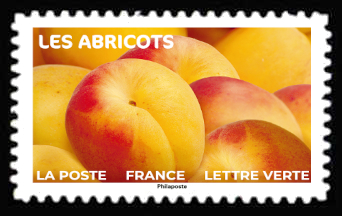
D'après photographies © Godong / BSIP © Deslandes / Sucré salé © Alain Kubacsi / Biosphoto © Jean-Michel Groult / Biosphoto © Yann Avril / Biosphoto © Frédéric Tournay / Biosphoto © Lamontagne / Biosphoto © Michelle Garrett / Flora Press / Biosphoto © Antoine Boureau / Biosphoto © Michel Gunther / Biosphoto © Antoine Lorgnier / Onlyfrance.fr © Science Photo Library
Cachet premier jour 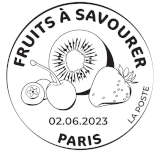
Fruits à Savourer
Premier jour :
Oblitération 1er jour au carré d'Encre 3 bis rue des Mathurins PARIS le 2 et 3 juin 2023
Vente générale : 5 juin 2023
Retrait de la vente : 30 juin 2025
Valeur faciale : 1.16 €€
Validité affranchissement : Lettre verte 20g pour la France, Andorre et Monaco
création : Aurélie Baras
Dentelure : 11¼
Couleur : Multicolore
Mode d'impression : Héliogravure
Format du timbre : 38 X 24 mm
Quantite émis : 3.000.000.
Bande phosphore : 1 barre à droite
Catalogue Yvert et Tellier Timbres français : N° 2296
Valeur marchande timbre neuf : 0,75 €
Valeur marchande timbre oblitéré : 0,24 €
NOTE : La valeur marchande est le produit des différentes cotes sur lesquelles est appliqué un coefficient réducteur de 70% (ce qui représente la valeur réelle du timbre en cas de vente)
Timbres présentants : Les Fleurs, arbres, plantes, champignons
Informations sur le sujet du timbre L'abricot
est le fruit d'un arbre généralement de petite taille appelé abricotier, de la famille des Rosaceae. Le nom scientifique de l'abricotier est Prunus armeniaca (prune d'Arménie). Il appartient au sous-genre des Prunus, section Armeniaca avec les quatre autres abricotiers du monde. La chair est sucrée, peu juteuse, jaune orangé et ferme la teneur en carotène ou provitamine A est élevée, c’est elle qui donne la couleur orangée et l’abricot est riche en pectines qui se gonflent facilement d’eau et qui lui confèrent son côté moelleux. L'abricot se sépare aisément en suivant le sillon médian.
La peau veloutée, dont la couleur peut aller du jaune au rouge, est parfois piquetée de « taches de rousseur » et se mange. La couleur rouge n’est pas gage de maturité (le degré de maturité est apprécié par le parfum et la souplesse du fruit) et l'abricot mûrit après sa cueillette : il est climactérique.
Source Wikipédia
Apricot
is the fruit of a tree generally called an apricot, small in size, belonging to the family Rosaceae. The scientific name of the apricot tree is Prunus armeniaca (Armenian plum). It belongs to the subgenus Prunus, section Armeniaca with the other four apricots of the world. The flesh is sweet, not very juicy, yellow-orange and firm, with a high content of carotene or provitamin A, which gives the orange colour and the apricot is rich in pectins that swell easily with water and give it its soft side. The apricot is easily separated by following the median groove.
The velvety skin, which can be yellow to red in colour, is sometimes spotted with «freckles» and eaten. The red colour is not a sign of maturity (the degree of maturity is appreciated by the fragrance and flexibility of the fruit) and the apricot ripens after picking: it is climacteric.
Source Wikipedia