Informations sur le sujet du timbre 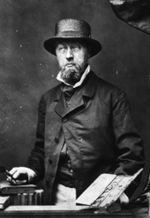
Johan Barthold Jongkind, photographie anonyme. (Image Wikipédia)
Johan Barthold Jongkind
peintre paysagiste hollandais vécut principalement en France où il fut très estimé de ses pairs et du public.
Connu comme « le peintre de Honfleur et des rues de Paris », Manet l'appelait « Le père du paysage moderne », et les jeunes peintres, furent séduits par son audace et ses natures qui annonçaient dès 1860 l'impressionnisme.
Jongkind met au point une manière de travailler novatrice : sur le terrain, il dessine de rapides croquis aquarellés où des touches de couleur permettent de saisir les impressions fugitives, qu'il annote éventuellement de précisions écrites. En atelier, il exécute, d'après ses croquis aquarellés et ses souvenirs, des toiles plus construites. Il innove aussi en éclaircissant fortement sa palette et en introduisant des touches lumineuses traduisant la décomposition analytique de la lumière dont il se sert pour rendre les effets changeants (reflets, ciels...)
Source : divers documents internet dont Wikipédia
Johan Barthold Jongkind
Dutch landscape painter lived mainly in France where he was highly valued by his peers and the public.
Known as «the painter of Honfleur and the streets of Paris», Manet called him «the father of modern landscape», and young painters were seduced by his audacity and nature that announced from 1860 impressionism.
Jongkind develops an innovative way of working: in the field, he draws quick watercolor sketches where touches of color allow to capture fleeting impressions, which he eventually notes written details. In his studio, he creates more constructed paintings based on his watercolour sketches and memories. He also innovates by brightening his palette and introducing light touches translating the analytical decomposition of light which he uses to make the effects changing (reflections, sky...)
Source : various Internet documents including Wikipedia