Informations sur le sujet du timbre 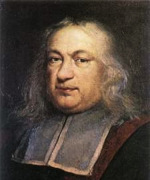
Pierre Fermat (Image Wikipédia)
Pierre de Fermat
né dans la première décennie du XVIIe siècle, à Beaumont-de-Lomagne (département actuel de Tarn-et-Garonne), près de Montauban, et mort le 12 janvier 1665 à Castres (département actuel du Tarn), est un magistrat, polymathe et surtout mathématicien français, surnommé « le prince des amateurs » Il s'est intéressé aux sciences et en particulier à la physique on lui doit notamment le principe de Fermat en optique. Il est particulièrement connu pour avoir énoncé le dernier théorème de Fermat, dont la démonstration n'a été établie que plus de 300 ans plus tard par le mathématicien britannique Andrew Wiles en 1994.
Pierre de Fermat était un génial mathématicien, qui a contribué avec Descartes à la création de la géométrie analytique, à celle du calcul infinitésimal, et à celle du calcul des probabilités (avec Pascal). C'est surtout le fondateur de la théorie moderne des nombres, la branche des mathématiques qui étudie les nombres entiers.
Source : divers documents internet dont Wikipédia
Pierre de Fermat
born in the first decade of the 17th century, in Beaumont-de-Lomagne (present day Tarn-et-Garonne), near Montauban, and died on 12 January 1665 in Castres (current Tarn), was a magistrate, polymath and especially a French mathematician, nicknamed «the prince of amateurs» He was interested in sciences and in particular in physics, we owe him in particular the principle of Fermat in optics. He is particularly well known for stating Fermat’s last theorem, the proof of which was not established until more than 300 years later by the British mathematician Andrew Wiles in 1994.
Pierre de Fermat was a brilliant mathematician, who contributed with Descartes to the creation of analytical geometry, that of infinitesimal calculus, and that of probability calculation (with Pascal). He is the founder of modern number theory, the branch of mathematics that studies whole numbers.
Source : various Internet documents including Wikipedia