Informations sur le sujet du timbre 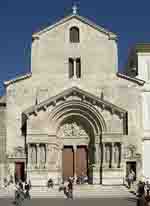
Cloitre de St Trophime (Image Wikipédia)
Le cloître Saint-Trophime
est au centre des bâtiments canoniaux de la cité épiscopale. A partir du XIIe siècle, l'espace au sud de la cathédrale Saint-Trophime est occupé par deux grands ensembles : d'une part, le palais de l'évêque, d'autre part, le claustrum, un espace réservé à la communauté des chanoines, « ceux qui vivent selon la loi de l'Eglise». ..Vers cette époque, le Chapitre d'Arles est touché par la réforme grégorienne. Celle-ci tente d'imposer une règle de vie commune à ces clercs chargés d'assister l'évêque et de gérer les biens de l'Eglise. On entreprit donc la construction de bâtiments conventuels organisés autour d'un cloître. ..Les deux premières galeries, romanes, de ce dernier, présentent des sculptures d'une exceptionnelle qualité, véritables fleurons de l'art roman provençal. L'édifice sera complété au XIVe siècle de deux autres galeries de style gothique...Les modifications ultérieures de la cité épiscopale préserveront le cloître et ses salles adjacentes. Cependant le temps, l'érosion pluviale et la pollution atmosphérique mettront à mal ces joyaux de la statuaire médiévale...Actuellement des études sont menées afin de procéder, comme sur le portail de l'église voisine, à une restauration de l'édifice
Source : divers documents internet dont Wikipédia
The cloister of Saint-Trophime
is at the centre of the chancel buildings of the episcopal city. From the 12th century onwards, the area south of the Saint-Trophime cathedral was occupied by two large buildings: on one hand, the bishop’s palace, and on the other, the claustrum, a space reserved for the community of canons, «those who live according to the law of the Church». Around this time, the Chapter of Arles is affected by the Gregorian reform. The latter attempts to impose a common rule of life on these clerics who are responsible for assisting the bishop and managing the property of the Church. So the construction of conventual buildings organized around a cloister was undertaken. The first two galleries, Romanesque, of the latter, present sculptures of exceptional quality, true jewels of Provencal Romanesque art. The building will be completed in the fourteenth century by two other galleries of Gothic style... The subsequent modifications of the episcopal city will preserve the cloister and its adjacent rooms. However, time, rain erosion and air pollution will damage these jewels of medieval statuary... Studies are currently being carried out to restore the building, as in the case of the portal of the neighbouring church
Source : various Internet documents including Wikipedia